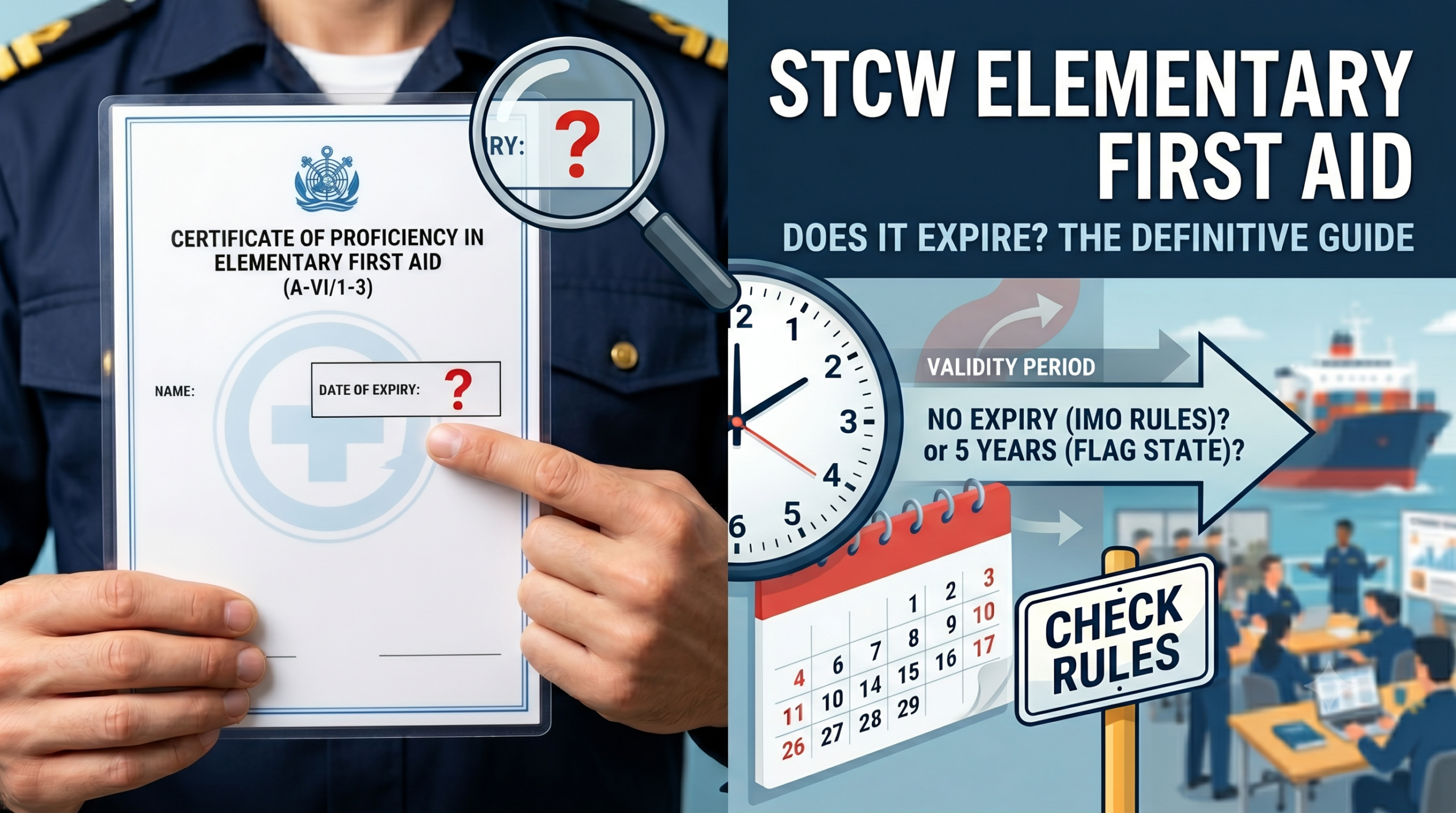
If you are looking to renew your maritime safety certificates, you’ve likely come across the term “Self-Declaration Route.” But what exactly does it mean, and how does it change your training at our centre?
Simply put, the Self-Declaration route is a way for active seafarers to shorten their shore-based training by proving they have stayed sharp while at sea.
The Definition: What are you declaring?
Under the STCW Manila Amendments, the Maritime and Coastguard Agency (MCA) acknowledges that if you are working on a professional vessel, you are already performing safety drills.
By signing a Self-Declaration form, you are legally confirming that within the last five years, you have participated in specific onboard drills (such as abandoning ship or launching life rafts) on an IMO-registered vessel.
How it saves you time:
- Route 1 (Self-Declaration): If you can sign the form, you only need to attend a half-day practical session. We list this as Update Personal Survival Techniques – Self Declaration Route.
- Route 2 (Full Course): If you haven’t been at sea, can’t tick all the criteria or your vessel doesn’t have an IMO number, you must attend the full-day version of the course. We list this as Personal Survival Techniques 1 Day.
Check out the full form here and look for Annex B. (Don’t worry about filling it out yet, we have an online version you can fill in after booking).
⚠️ The Important Exception: Fire Prevention & Fire Fighting
While the “Self-Dec” route is a great time-saver for survival skills, it does not apply to everything.
One of the most common mistakes students make is assuming they can “Self-Dec” their fire fighting. You cannot. Update Fire Prevention & Fire Fighting (FPFF) is always a one-day course. The MCA requires all seafarers regardless of their rank or experience to undergo live, shore-based fire drills every five years. This ensures you can handle real heat, smoke, and SCBA (breathing apparatus) equipment in a controlled, high-pressure environment that simply cannot be replicated safely during a standard drill on a ship or yacht.
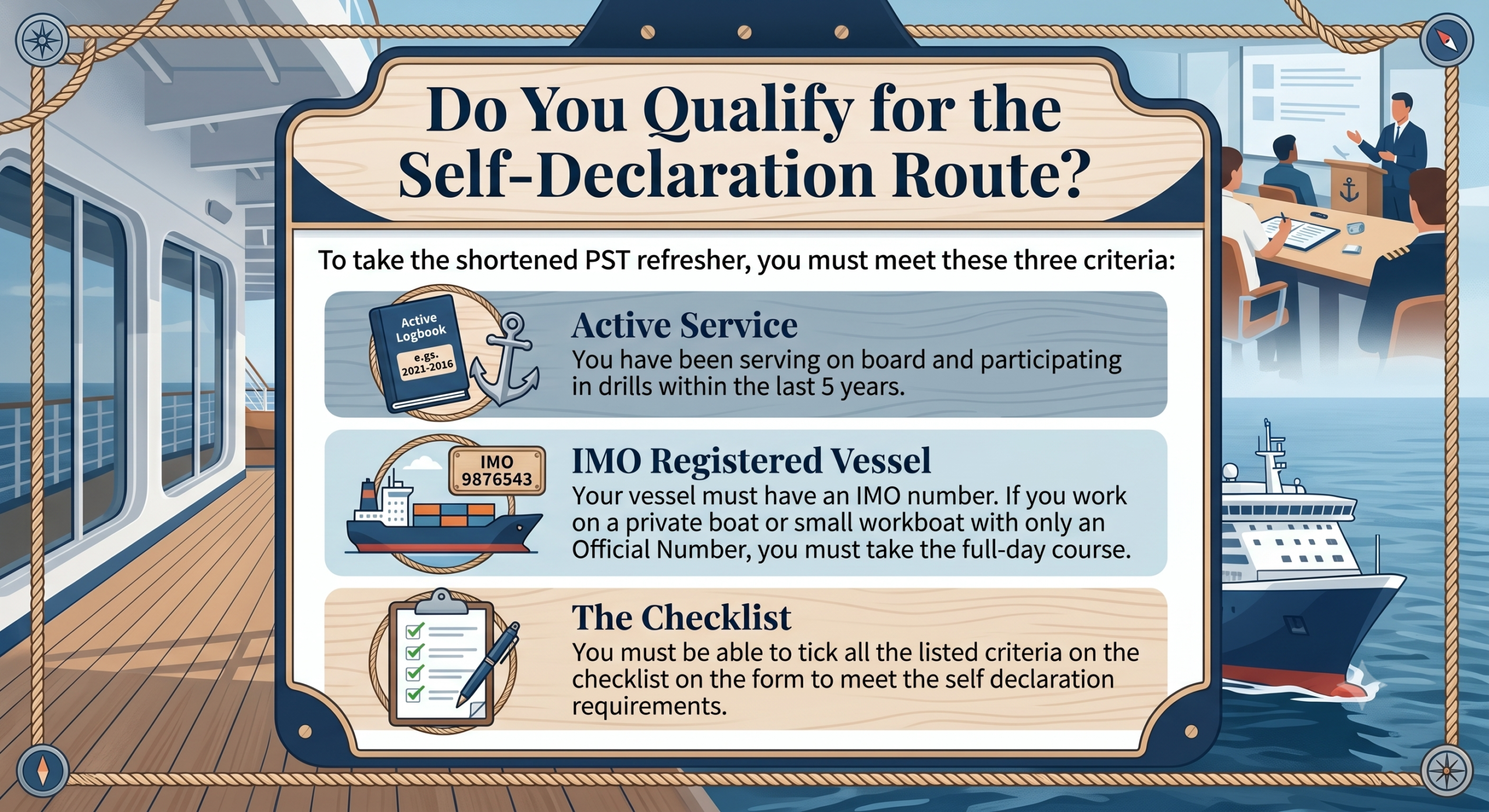
Do You Qualify for the Self-Declaration Route?
To take the shortened PST refresher, you must meet these three criteria:
- Active Service: You have been serving on board and participating in drills within the last 5 years.
- IMO Registered Vessel: Your vessel must have an IMO number. If you work on a private boat or small workboat with only an Official Number, you must take the full-day course.
- The Checklist: You must be able to tick all the listed criteria on the checklist on the form to meet the self declaration requirements.
Why Honesty is the Best Policy
The Self-Declaration is a legal document. The MCA and Port State Control can audit your vessel’s logbooks at any time to verify that the drills you declared actually took place. If you don’t meet all the criteria, don’t sweat it! Just book the full-day course with us. It’s a great way to refresh your knowledge in a safe environment and be ready in an emergency if ever required.
Common Questions: STCW PST Self-Declaration
Can I sign the self-declaration if I’ve been out of work?
It depends on your timeline. You must have been serving on board an IMO-registered vessel and participating in the relevant survival drills within the last five years. If you have been out of the industry for more than five years, you cannot use the self-declaration route and must attend the Full Day PST course to get back up to speed.
My vessel doesn’t have an IMO number. Can I still self-declare?
No. Under MCA guidelines (MSN 1865), the vessel must be IMO-registered. This is because IMO-registered ships have standardised logging and drill requirements that the MCA can verify. If your vessel only has an Official Number (common on smaller private yachts or local workboats), you must attend the Full Day Refresher.
Why is there no “Self-Dec” for the Fire Fighting update?
As mentioned above, the MCA requires all seafarers to undergo live, shore-based fire drills every five years. While you can practice “Abandon Ship” drills (PST) effectively on a vessel, it is nearly impossible to safely replicate the heat, smoke, and intensity of a real fire emergency on board without professional training facilities.
Does the MCA actually check these declarations?
Yes. The MCA and Port State Control (PSC) have the right to audit your vessel’s official logbooks or your personal training record (PTR). When you sign that form, you are making a legal declaration that the drills took place.
Do I still need my original PST certificate?
Yes. This is vital. Your “Update” certificate is not a replacement; it is an attachment. When being inspected on board or applying for a Certificate of Competency (CoC), you must be able to show your original “long course” certificate alongside your most recent refresher. We always recommend keeping digital scans, but you must have the physical copies available.
Ready to get compliant?
View our latest dates for the STCW basic refreshers, either individually:
Or book our Basic update package which includes the full day route as standard: